
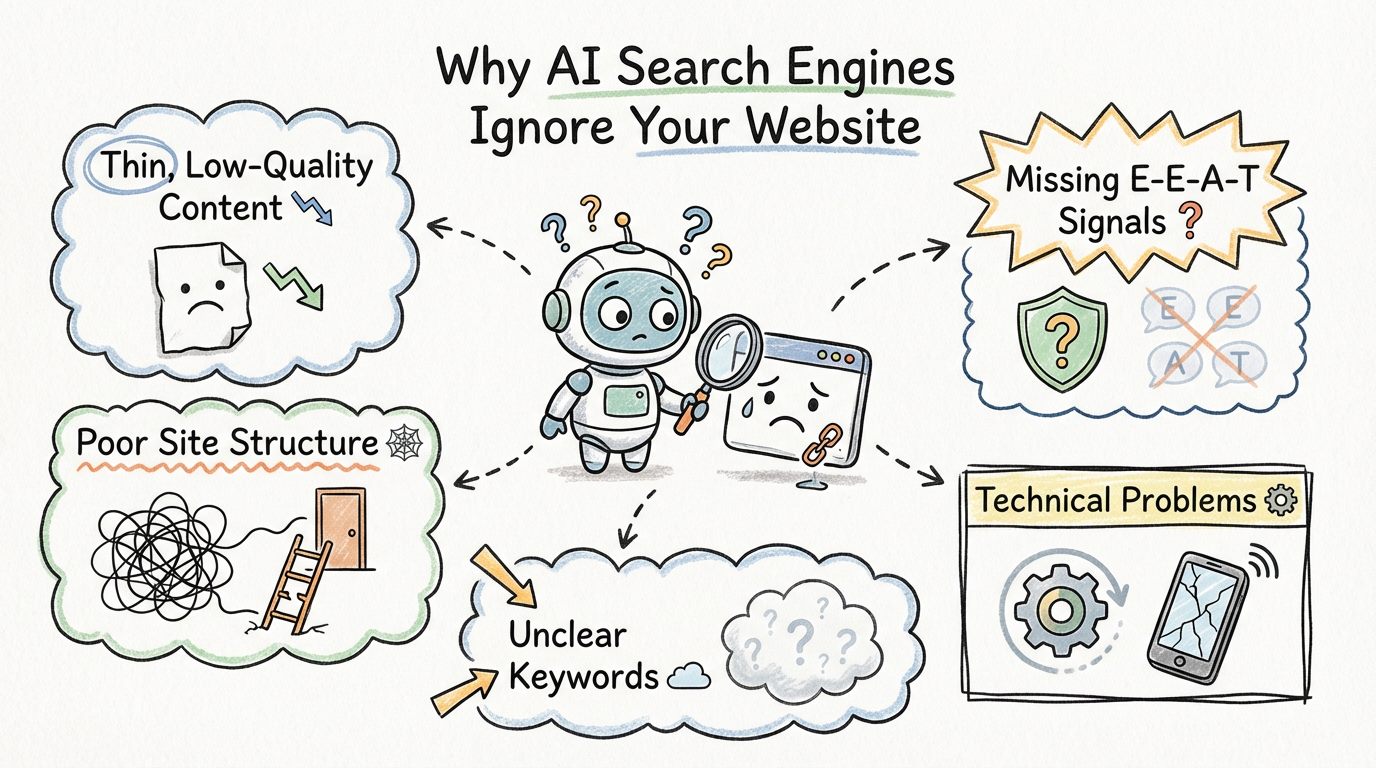
Free GEO Audit Tool: Find Out Why AI Search Engines Ignore Your Website
You rank #1 on Google. But when someone asks ChatGPT, Perplexity, or Claude about your industry — your brand never comes up. Here's how to diagnose the problem and fix it.
What a free GEO visibility audit should show
A useful GEO audit checks whether AI engines understand your category, mention your brand, cite your pages, and choose competitors instead. The goal is not another SEO checklist; it is a prioritized map of the evidence AI systems need before they include you in answers.
Start with the free AI search and GEO tools hub, public leaderboard, and trial credits. For technical checks, use the AI Crawler Access Checker and AI Citation Readiness Checker, then compare AI visibility tracking features or AIvsRank pricing when you need recurring prompt checks, competitor monitoring, and saved answer snapshots.
Free GEO audit FAQ
What is a GEO audit?
A GEO audit checks whether generative AI systems can identify your brand, category, competitors, pages, and evidence well enough to include you in AI-generated answers.
What can a free audit show?
It can reveal missing brand mentions, weak citation paths, competitor preference, unclear category signals, and pages that need stronger answer-ready structure.
How is it different from a traditional SEO audit?
Traditional SEO audits focus on crawlability, keywords, links, and search result positions. A GEO audit focuses on answer inclusion, entity clarity, citations, and AI visibility across prompts.
Do I need to submit my website?
You can start from the public leaderboard and trial credits, then add a private tracker when you want recurring checks for specific prompts, brands, and competitors.
What Is Generative Engine Optimization (GEO)?
Generative Engine Optimization (GEO) is the practice of optimizing website content so that AI-powered search engines — ChatGPT, Claude, Perplexity, Gemini, and Google AI Overviews — can discover, understand, and cite it in their responses. Unlike traditional SEO, which focuses on link-based rankings, GEO focuses on making content extractable and trustworthy for large language models.
Research from Princeton and Georgia Tech found that GEO strategies can improve AI visibility by 115–415%, depending on the optimization technique applied.
Why Traditional SEO Tools Aren't Enough
Run your site through Ahrefs, Semrush, or Screaming Frog. You'll get a detailed picture of your traditional SEO health — Domain Rating, backlink profile, Core Web Vitals, meta tag coverage.
But none of these tools answer the questions that actually matter for AI search visibility: They do not tell you whether AI crawlers such as GPTBot, ClaudeBot, Google-Extended, or PerplexityBot can actually access your content. They do not show whether your pages contain self-contained, citation-ready passages that generative systems can extract and reuse. They also do not reveal whether your schema is strong enough to explain what your business and content actually are, or whether your brand signals remain consistent enough across public sources for AI systems to trust and recommend you.
These are GEO questions. And until now, answering them required manual detective work across a dozen different checks.
What Is geo-audit?
geo-audit is a free, open-source GEO audit tool built as a skill for Claude Code. It analyzes any website across four research-backed dimensions and produces a scored report with a prioritized fix plan.
One command. Full diagnosis.
Once installed, geo-audit can run a complete GEO evaluation from a single command. The setup is simple:
npx skills add Cognitic-Labs/geoskills
Then run your first audit with:
/geo-audit https://your-website.com
In under 3 minutes, you get a complete picture of why AI systems can — or can't — discover, understand, and cite your content. For full technical documentation, see the geo-audit docs.
The 4 Dimensions of a GEO Audit
geo-audit evaluates your site across 4 dimensions, weighted by their measured impact on AI citation probability:
1. Technical Accessibility (20% of score)
This is the foundation. If AI crawlers can't reach your content, nothing else matters.
geo-audit checks access for 11 AI crawlers — GPTBot, ClaudeBot, Google-Extended, PerplexityBot, Bytespider, Applebot-Extended, CCBot, Cohere, Amazonbot, FacebookBot, and Meta-ExternalAgent. Beyond crawler access, the tool reviews the technical conditions that influence whether AI systems can reliably discover and retrieve your content. That includes robots.txt restrictions, llms.txt availability, HTTPS and sitemap coverage, and the delivery conditions that may affect retrieval quality.
Common finding: Many sites that score 90+ on traditional SEO audits block GPTBot and ClaudeBot in robots.txt without realizing it.
2. Content Citability (35% of score)
This is the biggest factor. Content citability measures how easily an AI system can extract, understand, and quote a passage from your page.
geo-audit analyzes five sub-dimensions. These focus on whether content can be extracted cleanly, whether its meaning is specific enough to stand on its own, whether claims are supported with enough context, whether formatting helps machine interpretation, and whether individual sections remain coherent when retrieved independently.
Common finding: Blog posts optimized for keyword density often score poorly on citability because they lack self-contained, extractable passages.
3. Structured Data (20% of score)
JSON-LD schema tells AI systems what your content is before they even read it. Proper structured data acts as a machine-readable summary that helps AI engines identify your brand, your content type, and your expertise.
At the structured-data level, geo-audit looks at whether key pages use JSON-LD, whether organization and identity markup are present, whether content types such as FAQ, Article, or Product are correctly described, and whether the markup is complete enough to support machine interpretation.
When schemas are missing, geo-audit generates ready-to-use JSON-LD templates you can paste directly into your pages.
Common finding: Even sites with schema markup often miss sameAs on Organization schema — the property that connects your brand identity across platforms.
4. Entity & Brand Signals (25% of score)
AI systems build brand understanding from multiple sources, not just your website. If you don't exist outside your own domain, AI doesn't know how to trust or recommend you.
It evaluates whether your brand is described consistently across public sources, whether third-party references reinforce your authority, whether your entity signals align with how knowledge systems interpret your business, and whether your brand description remains stable enough to support accurate recommendation and citation.
Common finding: Brands with strong SEO but no Wikipedia presence or cross-platform consistency score 20–30 points lower than expected on AI visibility.
Key Research Findings Behind the GEO Score
The scoring methodology behind the GEO Score is not based on guesswork. It synthesizes insights from 101+ research sources, including the Princeton / Georgia Tech GEO paper, BrightEdge’s AI citation studies, and SparkToro’s research on zero-click search behavior.
Several key data points played a major role in shaping the weighting model:
Content optimization strategies improve AI visibility: 115–415%
Source: Aggarwal et al., Princeton / Georgia Tech (2023)
Expert quotations increase AI citation probability: +41%
Source: BrightEdge (2024)
Statistical content earns more AI citations: +30%
Source: BrightEdge (2024)
Consistent cross-source brand signals boost citation rate: 2.5×
Source: SparkToro / Zyppy (2025)
These research findings collectively inform how different signals are weighted within the GEO Score model.
GEO Score Grades
geo-audit produces a composite GEO score from 0 to 100 using the formula: Technical × 0.20 + Citability × 0.35 + Schema × 0.20 + Brand × 0.25.
A
85–100
AI-optimized. You're likely being cited by major AI engines.
B
70–84
Strong foundation. A few targeted fixes can push you to A-tier.
C
50–69
Significant gaps exist. A structured 30-day plan is recommended.
D
30–49
Major issues across multiple dimensions. Start with critical fixes.
F
0–29
Fundamental problems are blocking AI discovery entirely.
Every report includes prioritized issues sorted by point impact, specific fix instructions, ready-to-use JSON-LD templates, a top-5 quick wins list, and a 30-day improvement roadmap.
Diagnosis + Measurement: The Complete GEO Workflow
A GEO audit tells you what to fix. But how do you know if the fixes are working?
That's where measurement comes in. AIvsRank tracks your actual AI visibility over time — real mentions and citations across ChatGPT, Claude, Perplexity, Gemini, and Google AI Overviews.
Set an AIVSRANK_API_KEY in your environment, and geo-audit automatically enriches the report with live visibility data. Without a key, the tool works fully standalone.
The workflow: Audit → Fix → Measure → Repeat.
Get Started with geo-audit
geo-audit is free and open-source under the Apache-2.0 license.
Install the geoskills suite with:
npx skills add Cognitic-Labs/geoskills
Then run a full GEO audit against any public website:
/geo-audit https://your-website.com
Full documentation: geo-audit docs
Source code: github.com/Cognitic-Labs/geoskills
Frequently Asked Questions
What is a GEO audit?
A GEO audit is a systematic evaluation of how well a website is optimized for AI-powered search engines. It checks whether AI crawlers can access your content, whether your text is structured for citation, whether your schema markup helps AI understand your brand, and whether your entity signals are strong enough for AI systems to trust and recommend you.
How is GEO different from SEO?
SEO optimizes for link-based search rankings on Google and Bing. GEO optimizes for AI-powered engines — making content discoverable, citable, and recommendable by large language models like ChatGPT, Claude, Perplexity, and Gemini. A site can rank #1 on Google but be completely invisible to AI search.
Which AI platforms does geo-audit cover?
geo-audit checks crawler access for 11 AI bots: GPTBot (OpenAI/ChatGPT), Google-Extended (Gemini), ClaudeBot (Anthropic), PerplexityBot, Bytespider (ByteDance), Applebot-Extended, CCBot, Cohere, Amazonbot, FacebookBot, and Meta-ExternalAgent.
Is geo-audit really free?
Yes. geo-audit is open-source under the Apache-2.0 license. All features work without any API key. The optional AIvsRank API key adds real-time visibility measurements but is not required.
What is the GEO Score formula?
The composite GEO Score weights four dimensions: Technical Accessibility (20%), Content Citability (35%), Structured Data (20%), and Entity & Brand Signals (25%). The formula is: GEO Score = Technical × 0.20 + Citability × 0.35 + Schema × 0.20 + Brand × 0.25.
geo-audit is built by AIvsRank — the AI visibility measurement platform that tracks how brands appear across ChatGPT, Claude, Perplexity, Gemini, and Google AI Overviews.