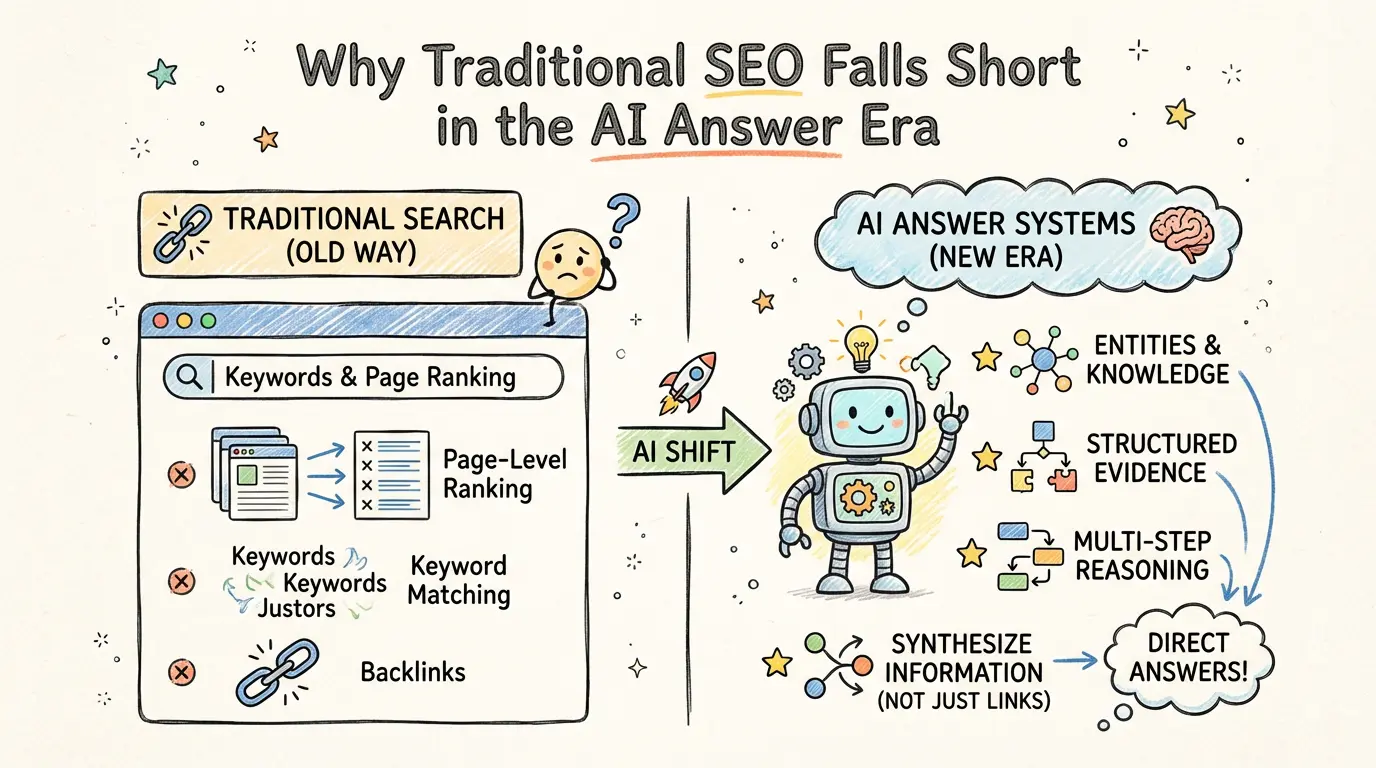
Traditional blog writing formats underperform in AI-first search because they are built for readers who click through, not AI systems that extract, verify, and cite standalone answer passages. A page can still rank in Google while failing to appear in AI-generated answers if its definitions, evidence, and brand entities are hard to reuse.
Why traditional blog formats underperform in AI-first search
AI-first search rewards pages that answer specific questions, expose clear entities, cite evidence, and connect brand claims to structured proof. A generic blog post can rank in blue links while still failing to appear in AI-generated answers because the model cannot easily extract a concise answer, verify the claim, or map the page to a known brand or category.
For teams comparing traditional SEO vs AI search, the practical gap is citation readiness. Content needs scannable sections, explicit definitions, current evidence, and internal links to product pages such as AIvsRank features and related resources like the free GEO audit guide.
Why this is AI search's PageRank moment
The reason traditional blog formats underperform in AI-first search is that AI answer engines add a second selection layer after discovery. Ranking in search can still make a page available, but citation depends on whether an AI system can select a passage, verify the claim, and reuse it inside an answer.
This is why the shift resembles an AI search PageRank moment. PageRank made links a proxy for authority. AI citations make extractable evidence, entity clarity, and source usefulness a proxy for answer inclusion.
1. The Context: Clicks Decline, Answers Persist
Multiple independent analyses show substantial shifts in user behavior and traffic distribution: These changes are not coming from a single platform or one isolated report. They appear across multiple kinds of research, including traffic analysis, large-scale keyword studies, and independent observations of how AI Overviews affect clicks. Taken together, they point to the same trend: users are increasingly getting answers on the results page itself instead of clicking through to websites.
AI Overviews reduce click-through rates to top organic results by 30–35%, with some categories reporting 40–80% declines on affected queries.
Data from Similarweb indicates news-related Google traffic dropped from roughly 2.3 billion to under 1.7 billion visits year-over-year as zero-click searches increased from 56% to 69% with AI summaries.
A Semrush study of 10 million keywords shows widespread adoption of AI Overviews, heavily concentrated in informational queries where answers are compressible.
The implication is straightforward:
Traditional SEO aims for documents that attract clicks.
AI SEO aims for facts, entities, and structured evidence that can be selected and integrated directly into an AI-generated answer.
This shift is not just about declining traffic, but about a change in what visibility means: brands increasingly need to be included in the answer itself, not just compete for the click.
This does not mean traditional SEO no longer matters. It means traditional SEO solves the problem of being discovered, while AI SEO extends that goal by solving the problems of being used and being cited. AIvsRank's article AI SEO vs Traditional SEO: What Actually Changes in Day-to-Day Execution? expands this distinction at the workflow level.
This shift is especially important for brands that rely on educational content, comparison pages, and high-intent informational queries for traffic. The remainder of this article covers tactics that exist specifically within this AI-native environment. To understand the tactics below, it helps to keep one core shift in mind: traditional SEO focuses on helping pages rank and win clicks, while AEO/GEO focuses on making content easy for AI systems to identify, break apart, extract, verify, and integrate into final answers.
2. Prompt Graph Coverage
Generative engines decompose a query into a graph of sub-tasks and reassemble the final answer using multi-step reasoning. Put simply, AI does not look for just one "most relevant page" the way traditional search often does. Instead, it breaks a complex query into smaller sub-questions and looks for content blocks that can be assembled into a final answer. The more important sub-tasks your content covers, the more likely it is to appear in that response.
Implications for optimization
A complex query, such as "best project management tools," is segmented into micro-prompts such as:
evaluation criteria
category comparisons
pricing structures
implementation timelines
AEO/GEO tactic
Design content mapped to predictable sub-tasks.
Ensure each section is self-contained and recoverable as a standalone answer block.
Title and structure micro-sections to match those sub-tasks.
Traditional SEO clusters long-tail keywords; AEO/GEO structures content around the model's internal reasoning graph. For example, when a user searches for "best project management tools for remote teams," traditional SEO may focus on publishing one comprehensive page around that keyword. AI systems, however, often break the query into sub-questions such as collaboration features, pricing range, learning curve, and integrations with tools like Slack or Google Workspace.
In practice, the content most likely to be used by AI is not just the page that targets the head term, but the one that provides reusable answer blocks for those sub-tasks. This is the same structural logic behind AIvsRank's guide on how to write an article that large language models prefer: sections need to be understandable as extractable answer units, not only as parts of a long page.
3. LLM Seeding
Unlike search engines, LLMs integrate knowledge directly into internal representations. This is not about "ranking a page" in the traditional sense.
Observed behavior
Analyses consistently show generative engines favor:
community documentation
public glossaries
government or standards sources
neutral, non-commercial references
AEO/GEO tactic
Publish definitions and canonical explanations in public, neutral environments.
Contribute to open documentation, Q&A repositories, and standards-oriented surfaces.
Ensure key concepts appear where models acquire foundational knowledge, not only on brand-owned pages.
The objective is not to rank a URL, but to influence where the model learns authoritative facts.
4. Passage-Level Retrieval Optimization
LLMs retrieve passage-level units, not full pages. This means it is not enough for the page as a whole to be strong. Each paragraph also needs to stand on its own.
Empirical findings
Citations in AI answers generally reference:
a single structured paragraph
a tightly scoped definition or comparison
a standalone table or evidence block
AEO/GEO tactic
Treat every H2/H3 section as an extractable reference.
Include the full claim, qualifier, and supporting data within the same passage.
Avoid requiring scroll-dependent context.
The goal is to create the clearest retrieval-ready paragraph available online for each micro-question.
This also means that, for AI visibility, content is not automatically better because it is longer; it is better when it is easier to extract and reuse as a standalone passage. A common contrast looks like this: a 3,000-word article may be strong overall, but if the information about implementation timeline is scattered across several paragraphs, AI has a harder time extracting it. By comparison, a passage that clearly states, "A mid-sized SaaS team typically needs two to four weeks for implementation, assuming an existing CRM and ticketing stack is already in place," is much easier for AI systems to cite directly.
5. Citation-Ready Evidence Packaging
Generative engines prefer structured, verifiable information that can support factual grounding.
Positive citation signals
semantic HTML
clearly labeled sections
tables, timelines, and quantified comparisons
explicit sources
AEO/GEO tactic
Provide numerical ranges, definitions, and classifications in machine-friendly formats.
Pair claims with clear evidence.
Build "proof blocks" that can be lifted directly into an AI answer.
Accuracy alone is insufficient; structure determines reusability. For a practical page-level check, AIvsRank's AI Citation Readiness Checker reviews answerability, evidence density, entity clarity, and extractability. It is a useful diagnostic companion to this tactic, while still treating citation as a probabilistic outcome rather than a guarantee.
6. Neutrality Engineering
Generative systems deprioritize text that resembles promotional copy or subjective claims.
Observed tendencies
AI engines disproportionately weight neutral, descriptive content.
Google has broadened spam criteria to include shallow or non-substantive material.
Over-optimized sales language correlates with reduced retrieval visibility.
AEO/GEO tactic
Keep evidence-oriented passages strictly factual.
Place any subjective or promotional framing in sections not intended for citation.
Maintain a clear separation between informational content and opinion.
Neutrality increases the likelihood of inclusion in the answer-generation stage. This is also why content quality for AI search is not just about making text sound polished. AIvsRank's article on making AI-written content human and citation-ready makes the same point from the editing side: the strongest AI-assisted content is specific, structured, and source-worthy.
7. Brand-Entity Memory Alignment
Models rely on entity consistency across the public corpus.
Observed issues
Different engines often describe the same brand inconsistently, especially when external profiles conflict or are incomplete.
AEO/GEO tactic
Define canonical facts: function, scope, audience, location, key attributes.
Ensure consistency across major third-party profiles such as directories, data platforms, and media bios.
Resolve outdated or contradictory public descriptions.
This strengthens the model's internal representation of the entity, improving citation precision.
When these public signals remain inconsistent over time, AI systems not only become less likely to describe you accurately, but also less likely to surface you consistently in the right query contexts.
A common real-world problem is this: the company website describes the product as an "AI visibility platform," a media article calls it an "SEO analytics tool," and a software directory lists it as "brand monitoring software." None of these labels are entirely wrong, but when they coexist for long enough, AI systems may struggle to form a stable understanding of the brand's core category, reducing the chance of appearing in the right query contexts.
The AI Search Visibility Checker is a useful follow-up here because it checks whether AI answer engines mention, recommend, or cite a brand at all. If a brand is absent in relevant prompts, the issue may be entity memory and category association, not just page-level SEO.
8. Competitor Co-Occurrence Structuring
Comparative prompts drive significant decision-making behavior in AI search.
Observed pattern
Brands frequently referenced in "vs." or "best for" queries share common traits:
balanced third-party comparisons
consistent inclusion in category roundups
neutral, evidence-based descriptions
AEO/GEO tactic
Publish objective comparisons involving your entity and competitors.
Encourage third-party analysts and reviewers to include your brand in category discussions.
Prioritize transparency over positioning.
Rather than ranking for competitor terms, AEO/GEO focuses on establishing default peer set presence. AIvsRank's public leaderboard helps teams look at this competitive layer from the outside: which brands are already appearing in AI visibility views, and which categories have stronger default winners. The article How AIvsRank Leaderboard Measures Who Really Ranks at the Top explains why repeated recommendation patterns are more useful than a single prompt screenshot.
9. Source Blending Strategy
AI answers integrate content from multiple domain types, not only brand websites.
Documented blend
community Q&A
academic publications
documentation
standards and regulatory sites
neutral reviews
topical blogs
AEO/GEO tactic
Treat your digital footprint as an ecosystem.
Identify the non-Google surfaces influential in your domain and contribute accurate, consistent material.
Maintain identical core facts across environments to reduce ambiguity.
Generative retrieval is shaped by corpus composition, not by a single index. This is close to the "second selection layer" described in AI Search Is Entering Its PageRank Moment: being found once is not enough if the source does not survive selection, synthesis, and attribution.
10. LLM-Friendly Specification Publishing
Generative systems perform strongly when provided with clear rules, definitions, and structured processes.
High-performing formats
stepwise procedures
criteria lists
parameterized definitions
frameworks and decision trees
AEO/GEO tactic
Convert key knowledge into explicit specifications.
Document methodologies with clear boundaries and edge cases.
Provide precise definitions rather than broad positioning.
This offers models a reusable schema, increasing visibility in answer construction. If a team wants to turn this into a practical diagnostic, the GEO Audit is the broadest free check because it looks across crawlability, understandability, citability, and readiness for AI answer monitoring.
11. Training-Surface Expansion
Optimization increasingly includes surfaces adjacent to training data and retrieval corpora.
Examples of training-adjacent surfaces
public datasets
open PDFs
academic or industry research summaries
GitHub repositories
community documentation
AEO/GEO tactic
Publish high-signal, non-promotional material in formats conducive to ingestion.
Use permissive licensing where appropriate.
Consider every public artifact a potential retrieval point.
The objective is not indiscriminate exposure, but strategic selection of where foundational information lives. Technical control and guidance files also matter here. AIvsRank's article on llms.txt and robots.txt as technical control layers explains the distinction between crawl access and AI-facing guidance. For hands-on checks, teams can use the AI Crawler Checker and the llms.txt Generator.
12. Anti-Hallucination Engineering
Hallucinations arise when coverage is incomplete or ambiguous.
Research findings
Even advanced models produce fabricated details when factual grounding is weak.
AEO/GEO tactic
Publish concise fact sheets detailing key attributes, pricing structures, and policies.
Monitor how engines currently describe your brand.
Address inconsistencies through clear, repeatable information across third-party surfaces.
The aim is to ensure models converge on a small set of consistent descriptions, reducing the probability of errors. The AI Overview Eligibility Checker can help catch technical blockers that limit answer-style eligibility, while the visibility checker helps teams observe how engines currently describe the brand.
13. Mention vs. Citation Optimization
In AI-generated answers, visibility has multiple states:
Not mentioned
Mentioned without citation
Mentioned and cited as evidence
Empirical insight
Citation likelihood correlates with:
structured formats
clarity of purpose
reliable metadata
corroboration from third-party sources
AEO/GEO tactic
Produce pages optimized both for narrative inclusion and evidence extraction.
Expand earned media to ensure neutral third-party sources can serve as citation anchors.
Measure mention vs. citation across engines and adjust accordingly.
This replaces the traditional "impression vs. click" metric with a more relevant "mention vs. citation" model. AIvsRank's article on what AI visibility measures is useful here because it separates mentions, recommendations, citations, and competitive context. For a broader workflow, the Free AI Search and GEO Tools hub gives teams a practical starting point before moving into recurring tracking.
How to make a traditional SEO article ready for AI answers
A traditional SEO article becomes more useful for AI search when it includes answer-ready definitions, explicit evidence, clear entities, and internal paths to product or diagnostic pages. Teams can start with the free AI search and GEO tools, then use the AI Citation Readiness Checker to test whether priority pages are structured for citation.
For recurring measurement, move from one-time diagnostics to an AI Visibility Tracker so you can monitor whether AI engines actually mention, recommend, or cite your brand over time.
FAQ: traditional SEO vs AI-first search
Can traditional SEO pages still rank but fail in AI answers?
Yes. A page can rank in blue links while still be hard for AI systems to cite if the answer is buried, the entities are vague, or the evidence is not packaged in a reusable passage.
What is the fastest way to improve AI citation readiness?
Start by rewriting important sections as standalone answer blocks: define the concept, state the claim, include supporting evidence, and link to the most relevant product, research, or diagnostic page.
How should teams measure AI search visibility?
Use GSC for impressions, rank, and CTR, then pair it with AI visibility tracking to see whether prompts produce brand mentions, recommendations, and citations across AI answer engines.
Conclusion: Operating in the Current AI Answer Environment
Key realities:
AI summaries contribute to substantial click declines, particularly for informational queries.
Platforms emphasize answer quality and user satisfaction while expanding AI-generated summaries.
Hallucinations remain a structural issue, mitigated only through stronger grounding.
What can be influenced is strategy:
Treat AEO/GEO as distinct from traditional SEO.
Design content for retrieval, grounding, and reuse within generative systems.
Optimize not only for ranking but for recoverability, neutrality, and factual clarity.
Traditional SEO remains relevant, but it no longer defines the entire visibility pipeline. AEO/GEO addresses the broader environment in which answers—not links—are the primary unit of value. From this perspective, AEO/GEO is not a replacement for traditional SEO, but an added layer of capability for an answer environment increasingly shaped by AI. The real optimization target is no longer just whether a page can rank, but whether content can be understood, trusted, used, and cited by AI systems.